
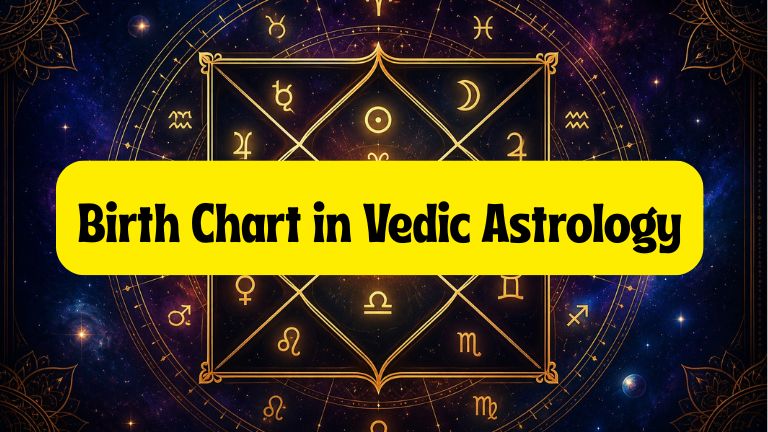
A Vedic birth chart is a snapshot of the cosmos at the precise moment of your birth. In Sanskrit, it’s called the Janam Kundali (also written as Janma Kundali), Janam Patrika, or simply the natal chart. This is the foundational document in Jyotish – the traditional Indian system of astrology that has been practised for over 2,000 years.
Birth astrology in the Vedic tradition is grounded in the sidereal zodiac. This is the key difference from Western astrology, which uses the tropical zodiac. The sidereal system tracks the actual positions of stars and constellations as they appear in the sky today, accounting for the slow wobble of the Earth’s axis (called precession). The tropical system doesn’t. This means your Vedic Sun sign is often one sign behind your Western Sun sign – and the entire chart looks different.
Astrology by date of birth alone isn’t enough in the Vedic system. You need three things:
- Exact date of birth
- Exact time of birth (ideally to the minute)
- Place of birth (city and country)
Without all three, the chart can’t be accurately cast. Astrology based on date and time of birth is non-negotiable in Jyotish – the birth time determines the Ascendant, which changes every two hours.
What does a Vedic birth chart contain?
The astrology chart in the Vedic system is built from four main layers. Together, they create a complete picture of who you are and what your life is likely to look like.
The 12 Houses (Bhavas)
Each house governs a specific area of life. Here’s a quick reference:
| House | Sanskrit Name | Life Area |
|---|---|---|
| 1st | Lagna / Tanu Bhava | Self, body, personality |
| 2nd | Dhana Bhava | Wealth, family, speech |
| 3rd | Sahaja Bhava | Siblings, courage, communication |
| 4th | Sukha Bhava | Home, mother, inner peace |
| 5th | Putra Bhava | Children, intelligence, creativity |
| 6th | Ripu Bhava | Health, enemies, daily work |
| 7th | Kalatra Bhava | Marriage, partnerships |
| 8th | Ayu Bhava | Longevity, transformation, hidden matters |
| 9th | Dharma Bhava | Luck, father, spirituality, higher learning |
| 10th | Karma Bhava | Career, status, public life |
| 11th | Labha Bhava | Gains, income, social networks |
| 12th | Vyaya Bhava | Expenses, losses, spiritual liberation |
The 9 Planets (Navagrahas)
Vedic astrology works with 9 celestial bodies: the Sun (Surya), Moon (Chandra), Mars (Mangala), Mercury (Budha), Jupiter (Guru), Venus (Shukra), Saturn (Shani), and the two lunar nodes – Rahu (North Node) and Ketu (South Node). Unlike Western astrology, Uranus, Neptune, and Pluto are not used.
Each planet sits in a house and a sign, and its placement tells the astrologer how that area of life is likely to unfold.
The Ascendant (Lagna)
The Lagna is the zodiac sign rising on the eastern horizon at the moment of birth. It’s the single most important point in the entire astrological birth chart. It sets the structure of all 12 houses and defines how you present yourself to the world. Two people born on the same day but two hours apart can have completely different Lagnas – and therefore completely different charts.
Nakshatras (Lunar Mansions)
This is one of the most distinctive features of the Jyotish astrology birth chart. The sky is divided into 27 Nakshatras, each spanning 13°20′ of the zodiac. Your Moon’s Nakshatra at birth determines the starting point of your Vimshottari Dasha – the planetary period system that times life events. Nakshatras add a layer of nuance that Western astrology simply doesn’t have.
North Indian vs South Indian Chart Styles
The same astrology chart data can be displayed in two visual formats:
- North Indian style: A diamond-shaped grid where houses are fixed in position and signs rotate. Most common in West Bengal, Bihar, and northern India.
- South Indian style (astrology south indian): A square grid where signs are fixed and houses rotate. Widely used in Tamil Nadu, Karnataka, Andhra Pradesh, and Kerala.
Both styles contain identical information. It’s purely a regional convention. In Kolkata and most of eastern India, the North Indian format is standard.
How is a Vedic birth chart calculated?
The calculation starts with your exact birth time and place. An astrologer – or software following classical rules – converts your local birth time to sidereal time, then calculates which zodiac degree was rising on the eastern horizon. That degree becomes the Lagna.
Most traditional practitioners follow the Parashari system, codified in the Brihat Parashara Hora Shastra – the foundational text of classical Jyotish, composed between the 7th and 8th centuries CE. This system uses whole-sign houses, the Vimshottari Dasha for timing, and a specific set of planetary aspects (drishtis) that differ from Western astrology.
Why does birth time matter so much? Because the Lagna shifts by roughly one degree every four minutes. A 15-minute error in birth time can move the Ascendant into a different sign entirely – changing the house rulerships and potentially the entire interpretation of the chart. Astrology by birth time and date isn’t just a formality. It’s the foundation.
If you’re unsure of your exact birth time, a skilled astrologer can use a technique called birth time rectification – cross-referencing known life events with the chart to narrow down the correct time.
An astrology chart by date of birth generated by an online tool uses the same mathematical process. The difference is what happens after the chart is drawn – which brings us to the next section.
What can your birth chart reveal about your life?
This is where the vedic astrology natal chart moves from astronomy to insight. A thorough kundali reading examines every major area of life:
Career and Professional Path
The 10th house (Karma Bhava) and its lord reveal your natural professional direction. Planets placed here – especially the Sun, Saturn, or Mercury – shape the kind of work you’re drawn to and how visible you’ll be in your field. The 10th house alone doesn’t tell the whole story; the Lagna, the 2nd house (income), and the 6th house (daily work environment) all contribute.
Marriage and Relationships
The 7th house is the primary house of marriage and long-term partnerships. Its lord, any planets placed there, and aspects from other planets all influence the timing, nature, and quality of your relationships. Venus’s placement adds another layer.
Health Tendencies
The 6th house governs health challenges and the body’s vulnerabilities. The 1st house (the body itself) and the 8th house (chronic or hidden conditions) are also read together. This doesn’t mean the chart predicts illness – it highlights areas to be mindful of.
Wealth and Financial Prospects
The 2nd house (accumulated wealth, family resources) and the 11th house (income, gains) work together to show financial potential. Specific planetary combinations – called yogas – can indicate periods of significant financial growth or difficulty.
Spiritual Inclinations
The 12th house (Vyaya Bhava) governs spiritual liberation, foreign travel, and retreat from the material world. A strongly placed 12th house, or a connection between the 9th and 12th houses, often shows someone with deep spiritual leanings.
Dasha Periods – When Things Happen
One of the most powerful tools in astrology chart analysis is the Vimshottari Dasha system. This divides life into planetary periods totalling 120 years. Each planet rules a period of a specific length:
| Planet | Dasha Duration |
|---|---|
| Sun | 6 years |
| Moon | 10 years |
| Mars | 7 years |
| Rahu | 18 years |
| Jupiter | 16 years |
| Saturn | 19 years |
| Mercury | 17 years |
| Ketu | 7 years |
| Venus | 20 years |
The sequence you’re born into depends on your Moon’s Nakshatra. During a planet’s Dasha period, its significations become active in your life. A Jupiter Dasha, for instance, often brings expansion, marriage, or children – but only if Jupiter is well-placed in the natal chart. Dashas explain why two people with similar charts experience different timings.
North Indian vs South Indian birth chart – what’s the difference?
If you’ve ever seen two Vedic charts that look completely different visually, this is why.
The North Indian chart uses a fixed diamond grid. The 1st house (Lagna) is always at the top-centre, and the signs rotate around it depending on your Ascendant. This format makes it easy to see house positions at a glance.
The South Indian chart – the format used in astrology south indian tradition – uses a fixed square grid where the 12 signs always appear in the same positions. The Lagna is marked with a diagonal line or the word “Asc.” Houses are counted from wherever the Lagna falls.
Both formats encode exactly the same planetary data. An astrologer trained in one format can read the other with a little adjustment. If you’re in Kolkata or anywhere in eastern India, you’ll almost certainly receive your chart in the North Indian format. If you’re consulting an astrologer from South India, expect the square grid.
Neither is more accurate. It’s a matter of regional convention, nothing more.
Can a free online birth chart replace a real consultation?
Short answer: no. Here’s why.
Free tools – and there are many good ones – will accurately calculate your astrology birth chart. They’ll place the planets in the right houses and signs. That part is mathematics, and software does it well.
What software can’t do is interpret the chart for your specific life situation.
A trained Jyotishi reads the chart holistically. That means:
- Identifying yogas – specific planetary combinations that modify outcomes significantly. There are hundreds of named yogas in classical texts. Some cancel each other out. Some amplify each other. A free tool won’t tell you which yogas in your chart are actually active.
- Reading the Dasha timeline – knowing that you have Saturn in the 7th house is one thing. Knowing that you’re currently in a Saturn Dasha, and that Saturn is also transiting your 7th house right now, is a completely different level of astrology chart analysis.
- Applying real-life context – the same placement means different things for different people. Mars in the 7th house for an Aries Lagna behaves very differently than Mars in the 7th house for a Libra Lagna. The entire chart must be read as a system, not as isolated placements.
- Giving practical guidance – a good consultation doesn’t just describe your chart. It tells you what to do with the information: timing decisions, understanding recurring patterns, and simple daily-life remedies where appropriate.
This is the difference between a map and a guide. You can have the map. But a guide who knows the terrain will get you there faster – and with fewer wrong turns.
How to get your Vedic birth chart read by an expert
What to prepare
Before your consultation, gather:
- Exact date of birth (day, month, year)
- Exact time of birth – from your birth certificate if possible, or from a parent’s clear memory. Even “around 6 in the morning” is better than nothing.
- Place of birth (city and country)
- Your main question or concern – career direction, marriage timing, business challenges, health patterns, or simply a general life reading
What to expect in a consultation
A thorough birth chart reading covers your Lagna, Moon sign, and Nakshatra first – these three form the foundation. From there, the astrologer examines the houses relevant to your question, checks the current and upcoming Dasha periods, and looks at active transits.
You’ll receive clear, practical observations – not vague generalities. If a remedy is suggested (a mantra, a dietary adjustment, a specific practice), it’ll be something you can realistically do in daily life. No false promises. No sensationalism.
Consultations with Proggy Aparamita cover:
- Career and professional direction – understanding your natural strengths and the timing of opportunities
- Marriage and relationships – compatibility, timing, and patterns in partnerships
- Business decisions – auspicious timing and potential challenges
- General life reading – a full overview of your chart’s key themes and current planetary periods
Book a personal birth chart reading to get a clear, grounded interpretation of your Janam Kundali – based on authentic Vedic calculations and years of practical experience
FAQ
What is a birth chart in Vedic astrology?
A birth chart in Vedic astrology – called the Janam Kundali – is a diagram showing the positions of the 9 planets across the 12 houses of the zodiac at the exact moment of your birth. It’s calculated using your birth date, time, and place, and it forms the basis of all Jyotish analysis.
How is a Vedic birth chart different from a Western birth chart?
The main difference is the zodiac system. Vedic astrology uses the sidereal zodiac, aligned with the actual positions of constellations in the sky. Western astrology uses the tropical zodiac, based on the seasons. Due to the precession of the equinoxes over 2,000+ years, the two systems are now about 23–24 degrees apart – which is why your Vedic Sun sign is often different from your Western one. Vedic astrology also uses Nakshatras and the Dasha timing system, which have no direct equivalent in Western astrology.
What information do I need to get my birth chart made?
You need three things: your exact date of birth, your exact time of birth (to the minute, ideally), and your place of birth (city and country). The birth time is critical – the Ascendant changes every two hours, and even a 15-minute error can alter the chart significantly.
Which house in the birth chart is most important?
The 1st house (Lagna) is considered the most important. It sets the structure of the entire chart, defines your physical body and personality, and determines which planet rules each of the 12 houses. The Moon sign and the 10th house (career) are also given significant weight in most readings.
Can I read my own birth chart without an astrologer?
You can learn the basics – what each house governs, what each planet signifies, what your Ascendant is. Many people do this and find it genuinely useful. But a full, accurate interpretation requires understanding how all the chart elements interact: yogas, Dasha timing, transits, and the specific context of your life. Most people find that even after years of self-study, a consultation with an experienced Jyotishi reveals things they’d missed entirely.
How accurate is Vedic astrology birth chart reading?
Accuracy depends heavily on two things: the precision of your birth data (especially the time) and the skill of the astrologer. A chart cast with an incorrect birth time will produce unreliable results. A chart read by someone with shallow knowledge will miss the nuances. When both are right – accurate data and a trained, experienced reader – Vedic astrology chart readings can be remarkably precise about personality patterns, life themes, and the timing of major events.
ALSO READ
How to Find a Genuine Tantrik in Kolkata
Business Astrology Consultation in Kolkata
Types of Rudraksha and Benefits in 2026
What is Vedic Astrology and How Is It Different from Western Astrology
Best Astrologer in Hatiara, Kolkata
Best Astrologer in Raghunathpur Kolkata
Best Astrologer in Chinar Park